
 admin
admin‘Thắm Lại’ brings together four artists, Tường Danh, Như Xuân Hứa, Anh-Phuong Nguyen, and Vân-Nhi Nguyễn at Galerie Quynh, to examine desire as progress, tracing how women’s longing has shaped Vietnamese culture across centuries.
The exhibition takes its title from a line in “Mời trầu” (Offering Betel), a poem attributed to the poet Hồ Xuân Hương¹, referencing the concept of thắm lại, the act of becoming red again, a staining that accrues through repetition and the labors of wanting. At the heart of the show is the concept of duyên: a bond written in fate, carrying people into one another’s lives and out again.
John Balaban translates “Có phải duyên nhau thời thắm lại” as “If love is fated, you’ll chew it red.” But something shifts in translation. The word duyên has no English equivalent, it speaks to fate, to a destined connection that persists, the inevitability of certain bonds. Balaban’s line lands on the act: chewing betel until your teeth stain red, passion made physical, the labors of love. The Vietnamese lingers on the bond itself, and on thắm lại, the becoming red again, the staining that happens through repetition.
This exhibition follows this lineage. The artists here explore girlhood, womanhood, Vietnamese mythology, the labors of women in society, and the intimacies and conflicts of all of this, working with traditional craft, domestic labor, hospitality work, and emotional work (romantic, social, familial) as sites of production and connection. The gallery holds both the precision of ancestral techniques and the repetitive strain of contemporary labor systems, the actual conditions under which Vietnamese women have worked and continue to work.
From Xuân Hương’s poetic subversions to the practices here, Vietnamese women have articulated, preserved, and transformed culture through making and desiring. The exhibition asks: what is the work that stains us? What labor and what longing leave their marks, binding us to what came before and what comes next, the red deepening with each return?
Artist Tường Danh
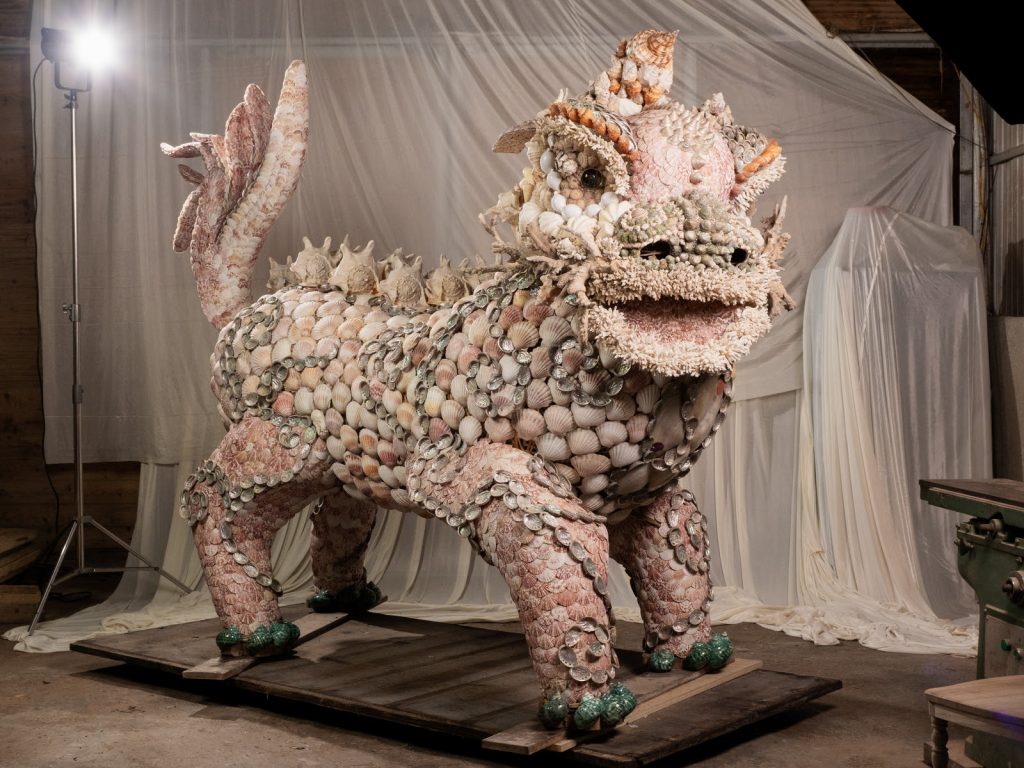
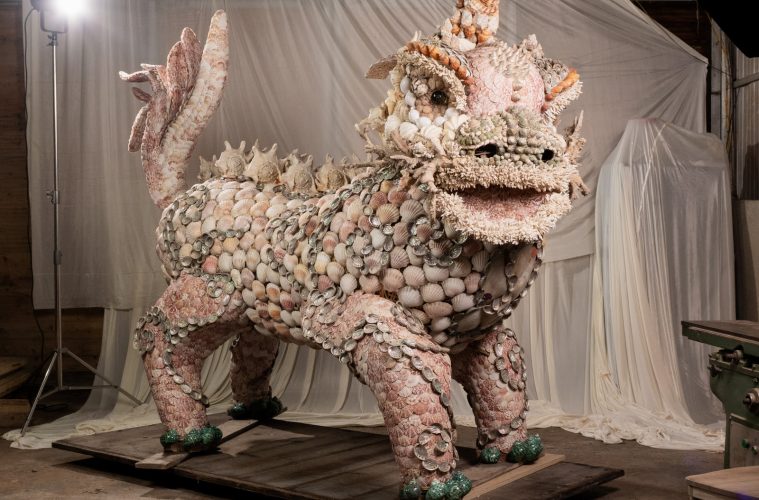
The exhibition opens with Lân Sư Hồ, a monumental sculpture by Tường Danh that emerges from a bed of sand as if surfacing from myth itself. The creature is Danh’s own, born from deep familiarity with the sacred beasts of Vietnamese and Chinese cosmology, the Dragon, Qilin, Turtle, and Phoenix, long woven into Vietnamese culture alongside more indigenous figures like Nghê and Hổ Phù. From these lineages Danh draws and reimagines: Lân Sư Hồ carries the dignified head of the Lân, the powerful body of the Sư, and the nimble tail of the Hồ³, embodying wisdom, courage, and holy power. Its construction is elemental: a calamus⁴ and papier-mâché head, a steel and bamboo body, its scales and fur inlaid with seashells and dead coral washed ashore in Quy Nhơn, Bình Định, and Phú Quý island. Colossal yet innocent, ancient yet present.
Artist Vân Nhi Nguyễn
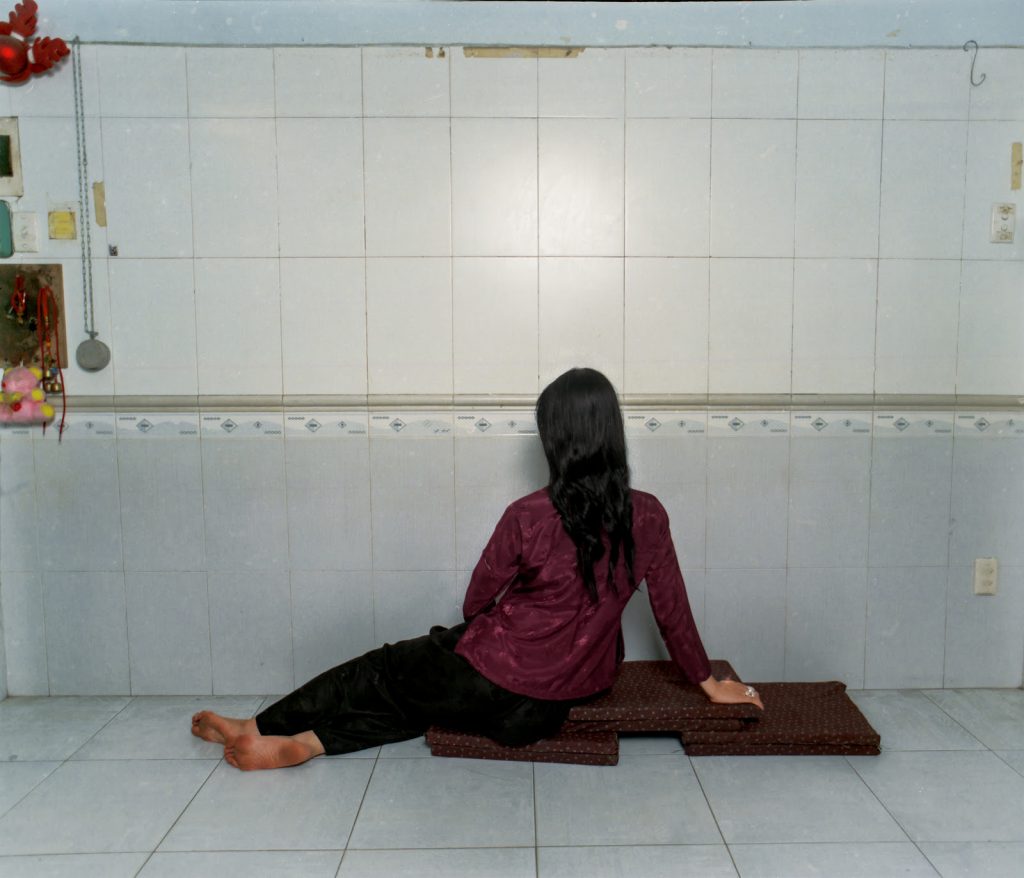
Vân-Nhi Nguyễn’s untitled photography series draws the viewer into the interior worlds of young women in contemporary Hanoi—their love, their grief, their shared moments of intimacy. Returning to the city after years abroad, Nguyễn found it reshaped by aggressive economic expansion, the demolition of historical sites, and the erasure of its youth’s cultural life. Against this, she turns her lens toward what persists: female friendship, quiet resistance, the tender textures of daily life theatricalized between fiction and reality, masculine and feminine. The work traces generational shifts from her mother’s era to her own, following how young Vietnamese women navigate the fracture between outward Western assimilation and inner cultural tradition.
Artist Anh Phương Nguyễn
Anh-Phuong Nguyen presents a new body of sculptural works animated by the tension and drama of surfaces, and by recurring obsessions with kitsch, replicas, and cultural cliché. Her most ambitious work to date, Las Vegas Symphony, returns here in a new iteration: three show-specific mechanised landscapes occupying the room. Two feature fields of glowing towel roses; a third stages a cloud and a palm tree in slow, motorized drift. In the middle of the room stands Hospitality Girl, a resin cast of a smiling woman, hand on hip, serving platter extended, a martini glass balanced and ready. She is the still center of the spectacle, the human figure the landscape has been built around. The work draws on the culture of hotel towel folding, treating the towel as an object of purity, romance, and fantasy, a surface through which ideals of beauty, landscape, and spectacle are mediated and performed. Neoclassical symmetry and aesthetic harmony are deployed here as tools of seduction, staging a world of choreographed desire in a darkened, silent room punctuated only by the steady hum of motors.
Artist Như Xuân Hứa
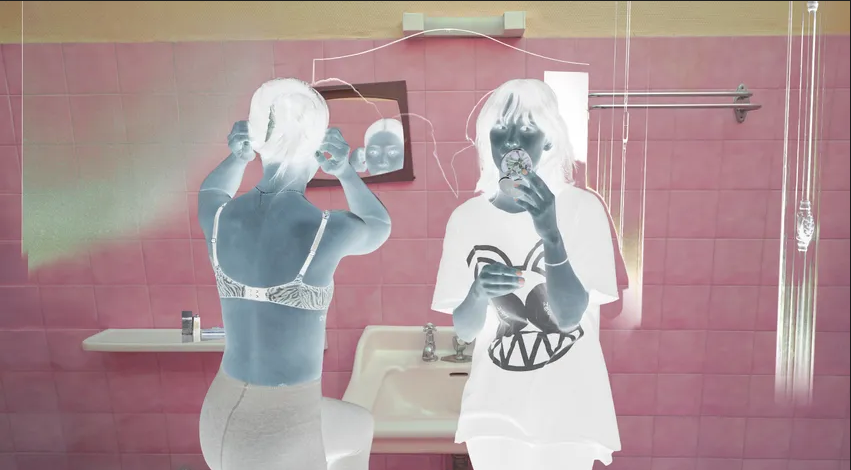
A selection from Như Xuân Hứa’s series Let the Horses Ride closes the exhibition, entered through a room whose entire floor is covered in green turf grass, playful, unexpected, an invitation to shed the weight of adulthood and meet the work with openness. The grass disarms before the photographs do their work, and the photographs ask something of you. In Gossip I and Gossip II, two women stand in a bathroom, one fixing her hair, one holding a compact to her face, caught in the unremarkable intimacy of getting ready. In Odalisque I, a girl reclines on a sofa with the ease and weight of an art historical odalisque, the pose at once referencing and reclaiming that tradition. The audience is a spectator to these scenes, pulled into moments that feel simultaneously staged and entirely true.
The exhibition opens from April 4 to May 30 at Galerie Quynh – 118 Nguyen Van Thu, Tan Dinh Ward, Ho Chi Minh City.